KWL News
Tipu Sultan: The Pioneer of Rocket and Missile Technology in History
In the history of military innovation, the name Tipu Sultan often appears as a remarkable pioneer of early rocket and missile technology. Many historians believe that Tipu Sultan, the ruler of the Kingdom of Mysore in the late 18th century, was among the first leaders to effectively develop and deploy war rockets in organized military combat. His innovative approach to warfare not only challenged the powerful British forces of that time but also laid the foundation for later advancements in modern missile systems.
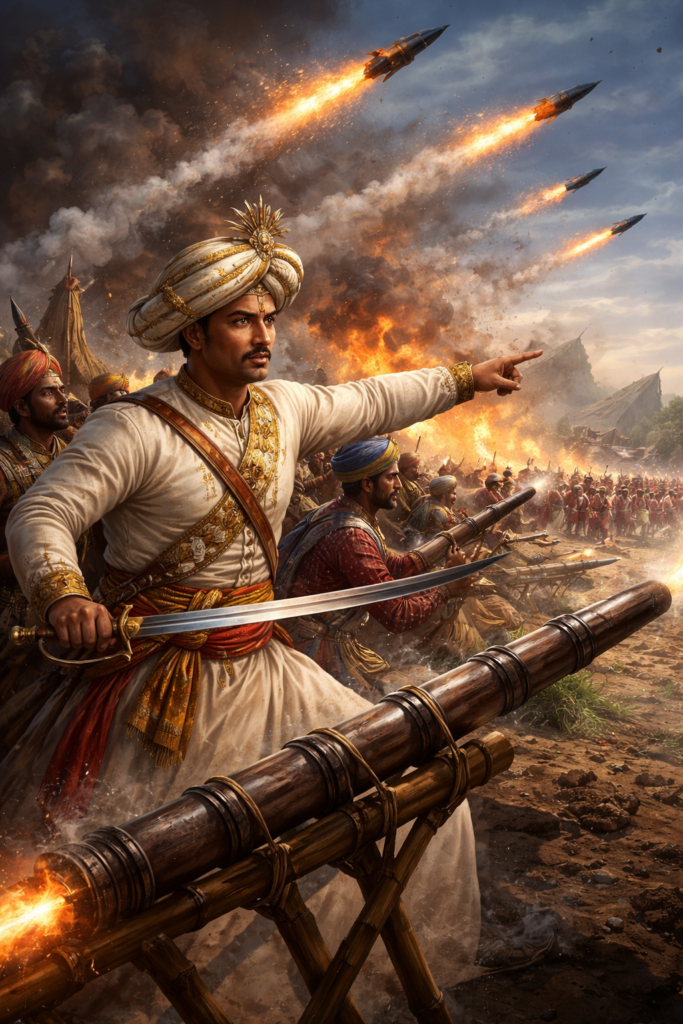
According to historical accounts, Tipu Sultan used military rockets against the British during the war of 1792. These rockets were not merely experimental devices; they were strategically designed weapons that formed an important part of his army’s combat tactics. The rockets created significant confusion and destruction among enemy ranks, proving to be highly effective on the battlefield. Their powerful impact surprised the British forces and caused considerable damage during the conflict.
What made Tipu Sultan’s rockets unique was their advanced construction and design for that era. Unlike earlier forms of rockets used in other regions, his rockets utilized iron casings filled with explosive materials. This design allowed them to travel farther and with greater force compared to traditional rockets made from weaker materials. As a result, these weapons could strike enemy positions more effectively and unpredictably.
The importance of Tipu Sultan’s contribution to rocket technology has also been acknowledged by prominent scientists. Dr. A. P. J. Abdul Kalam, former President of India and a globally respected aerospace scientist, openly recognized Tipu Sultan’s role in the early development of rocket systems. According to Dr. Kalam, the rockets used by Tipu Sultan represented one of the earliest forms of modern missile technology. This recognition highlights how the scientific ideas behind those early rockets eventually influenced future developments in military engineering.
Today, historical evidence of Tipu Sultan’s achievements still exists. Models of the rockets developed by Tipu Sultan are preserved in museums, including institutions in London. These artifacts demonstrate the technological creativity that existed in the Indian subcontinent during the 18th century. In addition, cannons and other weapons used in battles against British colonial forces are displayed in the British Museum, serving as reminders of a period when innovative warfare tactics challenged imperial expansion.
Interestingly, recognition of Tipu Sultan’s early rocket innovations is not limited to South Asian historical records. Displays related to early rocket development have also appeared in international science exhibitions and museums. For example, references to historical rocket designs, including those associated with Tipu Sultan, have been displayed in educational exhibits connected with aerospace history. Such recognition indicates that his work holds significance not only in regional history but also in the global story of technological progress.
Tipu Sultan’s legacy therefore extends beyond politics and military resistance. While he is widely remembered for his struggle against colonial rule, historians and researchers increasingly highlight his scientific and technological contributions. His development and military use of rockets illustrate how innovation can emerge even in times of intense conflict.
In conclusion, Tipu Sultan’s pioneering use of rockets in warfare marks an important chapter in the evolution of rocket and missile technology. His innovative weapons demonstrated the potential of rocket-based military systems long before modern missiles became a reality. Today, historians, scientists, and museums around the world continue to recognize his role as an early innovator whose ideas contributed to the broader history of aerospace and military technology.